



Sulawesi Cave Art: The World's Oldest Dated Rock Art and How to Visit
Oleh Redaksi Sulawesi.com8 menit baca
Sulawesi has the oldest dated cave art in the world, a hand stencil on Muna island at least 67,800 years old. This guide covers the dated finds and the caves visitors can enter.
Sulawesi has the oldest dated cave art in the world. A hand stencil in Liang Metanduno, a cave on Muna island in Southeast Sulawesi, is at least 67,800 years old (Nature, January 2026). In the Maros-Pangkep karst north of Makassar, a painted scene of a pig and three human-like figures is at least 51,200 years old (Nature, July 2024). This guide lists the dated finds and explains how scientists date them. It also says which caves visitors can enter and how to reach them.
Sulawesi cave art: the dated finds
| Study | Cave | Artwork | Minimum age |
|---|---|---|---|
| Nature, October 2014 | Leang Timpuseng, Maros | Hand stencil | 39,900 years |
| Nature, October 2014 | Leang Timpuseng, Maros | Pig painting, interpreted as a babirusa (pig-deer) | 35,400 years |
| Nature, December 2019 | Leang Bulu' Sipong 4, Pangkep | Hunting scene with pigs and anoas | 43,900 years; 48,000 after re-dating in 2024 |
| Science Advances, January 2021 | Leang Tedongnge, Maros-Pangkep border | Sulawesi warty pig, 136 cm long | 45,500 years |
| Nature, July 2024 | Leang Karampuang, Maros | A pig and three human-like figures | 51,200 years |
| Nature, January 2026 | Liang Metanduno, Muna island | Hand stencil | 67,800 years |
The 2014 study dated 12 hand stencils and two animal paintings in seven caves of the Maros karst. The 2019 hunting scene shows figures that appear to be part human and part animal. Scientists call such figures therianthropes. The 2024 study calls the Leang Karampuang scene the oldest known surviving example of representational art and of visual storytelling.
The Muna stencil is the oldest dated cave art anywhere. Its minimum age is 1,100 years greater than that of a hand stencil in Maltravieso cave, Spain. The team that dated the Spanish stencil attributes it to Neanderthals. Other researchers dispute that dating. The Muna team attributes its stencil to our own species, Homo sapiens.
Uranium-series dating: why every age is a minimum
Scientists date the thin mineral crusts that grew on top of the paint. These crusts are small calcite growths, also known as "cave popcorn". Calcite holds traces of uranium. Uranium decays into thorium at a known rate. The ratio of the two gives the age of the crust. The paint under a crust is older than the crust. So each date is a minimum age. The art itself can be older.
The 2024 study introduced a laser method that reads the layers closest to the paint. It raised the age of the Leang Bulu' Sipong 4 scene from at least 43,900 to at least 48,000 years.
Maros-Pangkep karst: about 300 painted caves
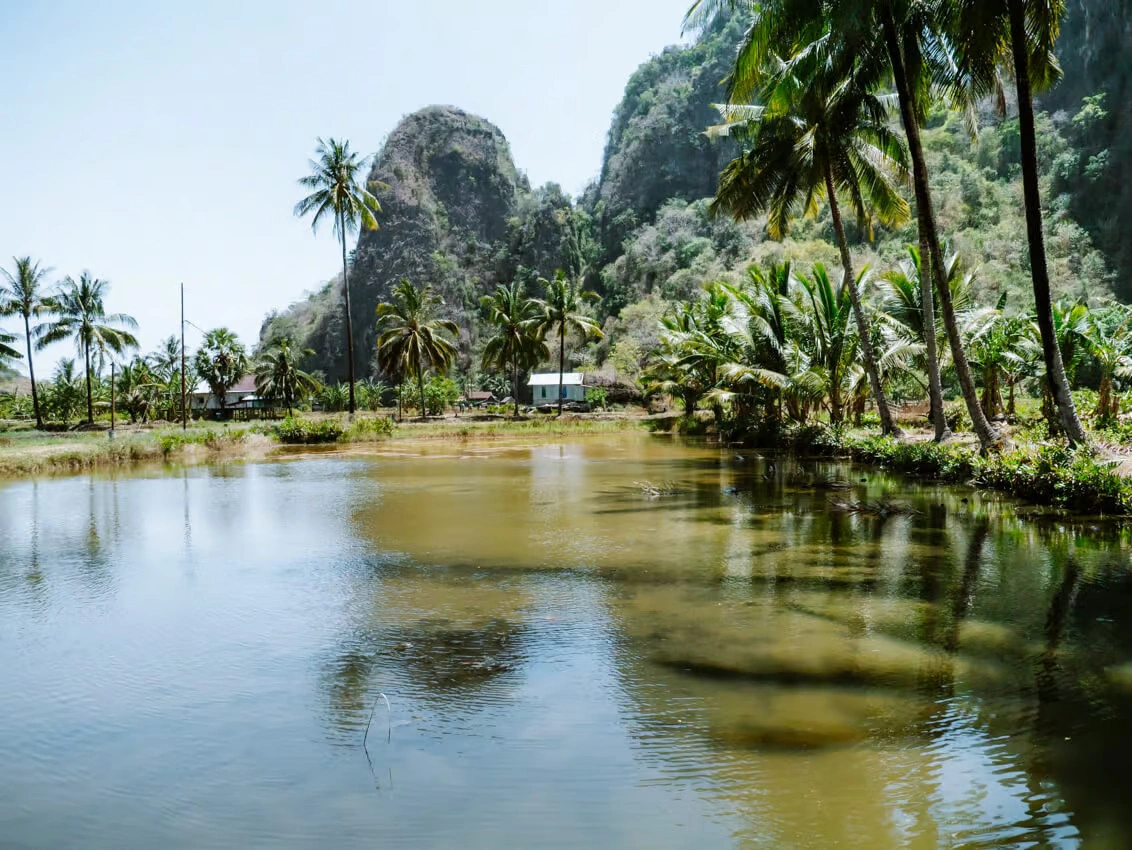
The Maros-Pangkep karst is a lowland area of limestone towers of about 450 km². It lies in the Maros and Pangkep regencies, north of Makassar. Researchers have found some 300 caves and rock shelters with paintings there. Leang means "cave" in the Bugis and Makassar languages. On 26 February 1950, C. H. M. Heeren-Palm, working with H. R. van Heekeren, found red hand stencils on the ceiling of Leang Pettae. They were the first paintings that archaeologists recorded in the karst.
The older art is hand stencils and animal paintings in red or dark purple. Most of the animals are pigs, mainly the Sulawesi warty pig. Anoas, the dwarf buffalo of Sulawesi, also appear. Black drawings in a later style date from after Austronesian-speaking farmers arrived, about 4,000 years ago. UNESCO named Maros-Pangkep a Global Geopark on 24 May 2023.
Leang-Leang Prehistoric Park: the art visitors can see
Leang-Leang Prehistoric Park (Taman Prasejarah Leang-Leang) has two painted caves open to the public. It lies in Leang-Leang, Bantimurung district, Maros regency. By road it is 27 km from Sultan Hasanuddin International Airport, which serves Makassar. Maros town is about 15 km away.
- Leang Pettae. Visitors climb 26 steps. The cave holds hand stencils and a painting of a leaping pig, often described as a babirusa. A gate protects the entrance.
- Leang Pettakere (also written Petta Kere). It is a short walk from Leang Pettae, up 64 steps. It holds more hand stencils and two pig paintings.
The pig in Leang Pettae has no direct date. It is in the style of the dated Ice Age paintings. In January 2025, the Ministry of Culture opened an information centre on the rock art at the park.
In January 2023, detikSulsel reported that the park opens daily from 08:00 to 16:00. It gave the ticket price as Rp 15,000. Check the current hours and price at the gate.
Record-dated caves: no published visiting arrangements
The caves with record dates are not the two open caves at Leang-Leang. No visiting arrangements for them are published.
- Leang Karampuang is in Samangki village, Simbang district, Maros, inside Bantimurung-Bulusaraung National Park. Flaking of the rock has erased much of its scene.
- Leang Bulu' Sipong 4 lies in a conservation area of the cement company PT Semen Tonasa, in Pangkep regency.
- Leang Tedongnge is in a secluded karst valley on the border of Maros and Pangkep.
Ask the heritage office, BPK Wilayah XIX in Makassar, before you try to visit any of them.
Rammang-Rammang and Bantimurung: nearby stops
- Rammang-Rammang, in Salenrang village, Bontoa district, Maros, is a karst area that visitors tour by boat. See the Rammang-Rammang guide.
- Bantimurung, about 9 km from Leang-Leang, has a waterfall and butterflies. In May 2024, the ticket was Rp 30,000 for Indonesians and Rp 255,000 for foreign visitors. See the Bantimurung butterflies guide.
Muna island: Liang Metanduno and Liang Kabori
Liang Metanduno and Liang Kabori are 25 m apart, in Liangkobori village (also written Liang Kabori), Lohia district, Muna regency. Sources put the village 10 to 16 km from Raha, the main town. Liang Metanduno is a tourist site. A simple staircase leads up to its entrance.
Most of the art that visitors see is much younger. A survey published in 1985 recorded 316 paintings in Liang Metanduno. They show people, horse riders, boats, deer, pigs, dogs, chickens and the sun. Most are in brown and red. Liang Kabori has hunting scenes, horse riders, people in boats and flying human figures. Chickens and dogs arrived with farmers about 4,000 to 3,500 years ago. Scenes with them are younger than that. Scenes with horses are unlikely to be more than 500 years old.
The dated stencil survives as a 14 × 10 cm patch of faded pigment. Reuters describes it as barely visible. The tip of one finger looks narrowed on purpose. Researchers have found this type of stencil only in Sulawesi. A second stencil on the same panel is at least 60,900 years old. A later painting of a bird, probably a chicken, sits between the two. Since 2019, the team behind the 2026 study has recorded 44 rock art sites in Southeast Sulawesi, 14 of them new.
Muna travel: visiting rules and boats
In July 2026, the Minister of Culture asked visitors not to touch the cave walls and to look from a distance. The ministry plans caretakers, a small museum and visiting rules. It also said it was listing the two caves as national heritage. No ticket price or opening hours are published. Ask in Liangkobori village. The village tourism page advises using a local guide.
Fast boats link Kendari and Raha. A new provincial fast boat started in February 2026. It takes about 2.5 hours. Boats also link Raha with Baubau. Check departure times at the port.
Cave art threats: salt, vandalism and fire
Much of the oldest art survives only as patches of faded pigment. Salt crystals grow under the hard outer skin of the limestone and push it off in flakes. A 2021 study found these salts at 11 cave art sites in Maros-Pangkep. Its authors argue that El Niño droughts, made worse by climate change, speed up the damage. They also name limestone quarrying for cement and marble as a threat.
A 2022 study reads the record differently. Photographs from 1950 show that most of the damage was already there. Its time-lapse photographs suggest that the rate of loss is now falling. The same study names vandalism, fumes from diesel traffic and cement dust as local threats. Vandals scratched away three patches of a pig painting in Leang Pettakere between 2009 and 2016.
Between 30 September and 18 October 2026, forest fires burned more than 270 hectares of Bantimurung-Bulusaraung National Park. They came within 800 metres of a painted cave. Archaeologists warn that heat and soot can damage the paintings. On Muna, a 2018 study reported vandalism, lichen and peeling paint in Liang Metanduno.
Do not touch the paintings or the cave walls. Never mark the rock.
How old is the cave art in Sulawesi? The oldest dated cave art in Sulawesi, and in the world, is a hand stencil in Liang Metanduno on Muna island. It is at least 67,800 years old (Nature, January 2026). In the Maros-Pangkep karst near Makassar, a scene of a pig and three human-like figures in Leang Karampuang is at least 51,200 years old (Nature, July 2024). Both are minimum ages from uranium-series dating of the mineral crust on top of the paint. Visitors can see hand stencils and pig paintings at Leang-Leang Prehistoric Park in Maros, 27 km by road from Makassar's airport.
Sources
Dating studies:
- Aubert et al., Pleistocene cave art from Sulawesi, Indonesia, Nature, 8 October 2014.
- Aubert et al., Earliest hunting scene in prehistoric art, Nature, 11 December 2019.
- Brumm et al., Oldest cave art found in Sulawesi, Science Advances, 13 January 2021.
- Oktaviana et al., Narrative cave art in Indonesia by 51,200 years ago, Nature, 3 July 2024.
- Oktaviana et al., Rock art from at least 67,800 years ago in Sulawesi, Nature, 21 January 2026.
- Will Dunham, Hand stencil in Indonesian cave seen as the oldest known rock art, Reuters via GMA News, 22 January 2026.
Condition and threats:
- Huntley et al., The effects of climate change on the Pleistocene rock art of Sulawesi, Scientific Reports, 13 May 2021.
- Gagan et al., The historical impact of anthropogenic air-borne sulphur on the Pleistocene rock art of Sulawesi, Scientific Reports, 13 December 2022.
- Fire in Bantimurung-Bulusaraung National Park (in Indonesian), detikSulsel, 15 October 2026.
- The world's oldest cave paintings in Indonesia under threat of wildfires, Reuters via The Jakarta Post, 23 October 2026.
Visiting Maros-Pangkep:
- Leang-Leang caves, steps, distances, hours and ticket (in Indonesian), detikSulsel, 7 January 2023.
- Leang-Leang location, airport distance and the meaning of leang (in Indonesian), Maros regency government, February 2026.
- The 1950 discovery at Leang Pettae, Indonesian Ministry of Social Affairs, 9 October 2023.
- Leang-Leang information centre opening (in Indonesian), Liputan6, 14 January 2025.
- Leang Karampuang location (in Indonesian), detikTravel, 8 February 2026.
- Leang Bulu' Sipong 4, BRIN on Google Arts & Culture, undated.
- Visitors must follow the rules of BPK Wilayah XIX, Makassar (in Indonesian), Antara, 21 February 2025.
- Maros-Pangkep becomes a UNESCO Global Geopark (in Indonesian), detikSulsel, 25 May 2023.
- Rammang-Rammang location (in Indonesian), detikSulsel, 25 May 2023.
- Bantimurung ticket prices (in Indonesian), detikSulsel, 26 May 2024.
Visiting Muna:
- Adhi Agus Oktaviana, Hand stencils and boats in the painted rock art of the karst region of Muna Island, Southeast Sulawesi, in The Archaeology of Sulawesi, ANU Press, 2018.
- Riza Salman, Cave paintings of Muna (in Indonesian), Mongabay Indonesia, 25 February 2026.
- Liangkobori tourism village (in Indonesian), Jadesta, Ministry of Tourism, undated.
- Lohia Subdistrict in Figures 2021, BPS Muna, 24 September 2021.
- Minister of Culture visits Liangkabori and national heritage listing (in Indonesian), Antara, 12 July 2026.
- Southeast Sulawesi boosts inter-island connectivity to drive economy, Antara, 7 February 2026.
- Baubau shipping companies add boats before Eid (in Indonesian), Antara, 17 April 2022.
Lanjut baca
Semua artikel #cultureRedaksi Sulawesi.com18 Oktober 2026Pinisi Shipbuilding at Tana Beru: Inside the Bugis BoatyardBaca selengkapnya
 #cultureRedaksi Sulawesi.com18 Oktober 2026Attending a Toraja Rambu Solo' funeralBaca selengkapnya
 #cultureRedaksi Sulawesi.com18 Oktober 2026The Bajau at Mola, in the present tenseBaca selengkapnya